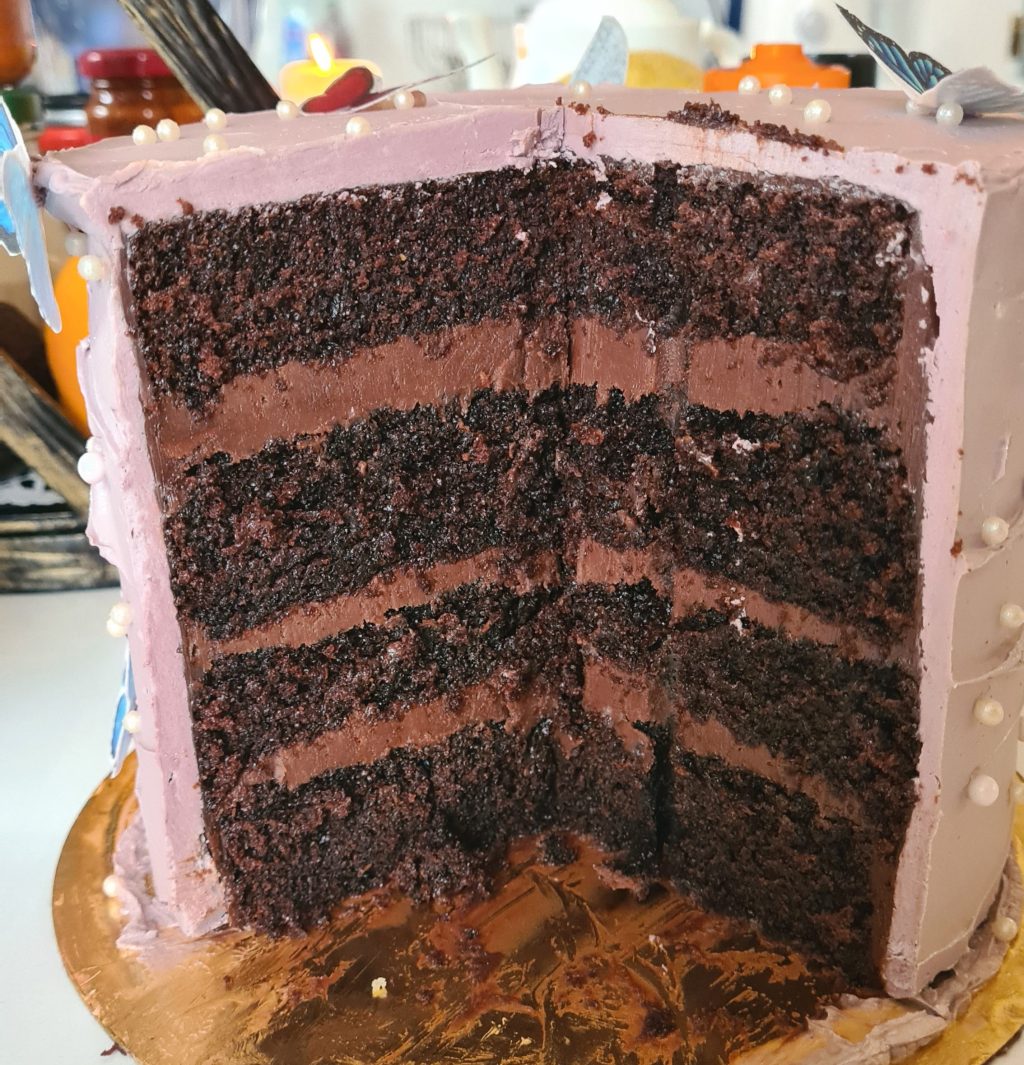
If you love chocolate cake but often end up with something a bit dry or underwhelming, this recipe is for you. This coffee buttermilk chocolate cake is simple to put together, but it also teaches a few helpful baking basics along the way—like why we use hot coffee, what buttermilk does, and how to mix your batter so the sponge stays light and fluffy. My goal is that you don’t just get a great cake today, but also pick up tips you can use in every cake you bake afterwards.
You’ll find clear, step‑by‑step instructions below, plus a handy tip to help you avoid a dense crumb. Take your time, enjoy the process, and let this become one of those “I can always rely on this” recipes in your kitchen.
Coffee Buttermilk Chocolate Cake
A rich, moist chocolate cake made with hot coffee and buttermilk for a deep flavour and beautifully tender crumb.
Serves: 10–12
Tin size: Two 8-inch (20 cm) round tins
Oven temperature: 165°C (no fan specified)
- Prep Time: 25 minutes
- Cook Time: 45 minutes
- Total Time: 1 hour 10 minutes
- Yield: 1 two‑layer 8-inch (20 cm) cake
- Difficulty: Easy
- Best for: Birthdays, celebrations, or anytime you want a reliable chocolate cake
Ingredients
- 525 g plain flour
- 550 g caster sugar
- 90 g cocoa powder
- 3/4 tsp salt
- 1.5 tsp bread soda (bicarbonate of soda)
- 350 ml instant coffee, hot (not boiling)
- 350 ml buttermilk
- 320 ml vegetable oil
- 5 large eggs
Method
- Preheat & prep tins
Preheat the oven to 165°C. Grease and line two 8-inch (20 cm) round tins with baking parchment. - Mix the dry ingredients
In a large bowl, whisk together the plain flour, caster sugar, cocoa powder, salt, and bread soda. Whisk well to remove any lumps. - Mix coffee, oil, buttermilk, then eggs
Brew the instant coffee and let it cool slightly so it is hot but not boiling.
In a jug or mixing bowl, whisk together the hot coffee, vegetable oil, and buttermilk.
Once combined, add the eggs and whisk again until the mixture is smooth. - Combine wet and dry
Pour the coffee–oil–buttermilk–egg mixture into the bowl with the dry ingredients.
Mix gently with a whisk or spatula until you have a smooth batter with no visible dry flour. The batter will be quite loose and pourable. - Fill the tins
Divide the batter evenly between the two prepared tins and smooth the tops gently with a spatula. - Bake
Bake for about 45 minutes, or until a skewer inserted into the centre of each cake comes out clean. - Cool
Leave the cakes to cool in the tins for 10–15 minutes. Then turn out onto a wire rack, peel off the baking paper, and allow to cool completely before icing or filling.
Helpful Tip
Do not overmix the cake batter. Once the wet and dry ingredients are combined and no dry flour remains, stop mixing. Overmixing develops the gluten in the flour and can make the cake heavy and dense instead of light and fluffy.
Baker’s Notes
Why use hot coffee?
Hot (not boiling) coffee helps “bloom” the cocoa, bringing out a deeper chocolate flavour. The cake won’t taste strongly of coffee, but it will taste richer and more chocolatey.
What does buttermilk do?
Buttermilk is slightly acidic. It reacts with the bread soda and helps tenderise the crumb, giving you a softer, moister cake. If you don’t have buttermilk, you can make a quick version by mixing 1 tablespoon of lemon juice or white vinegar into 250 ml milk, stirring, and letting it sit for 5–10 minutes before using.
How to avoid a dense cake
Once the wet and dry ingredients are combined and no dry flour remains, stop mixing. Overmixing develops gluten in the flour, which can make your cake heavy and chewy instead of light and fluffy.
Checking for doneness
Every oven is a little different. Start checking your cakes a few minutes before the 45‑minute mark. A skewer inserted into the centre should come out clean or with just a few moist crumbs, and the tops should spring back lightly when touched.
Storing and making ahead
- You can bake the layers a day ahead. Once completely cool, wrap them well in cling film and keep at room temperature.
- For longer storage, wrap and freeze the cooled layers for up to 2–3 months. Defrost at room temperature while still wrapped, then fill and frost.
 Beyond Cake Art
Leave a comment